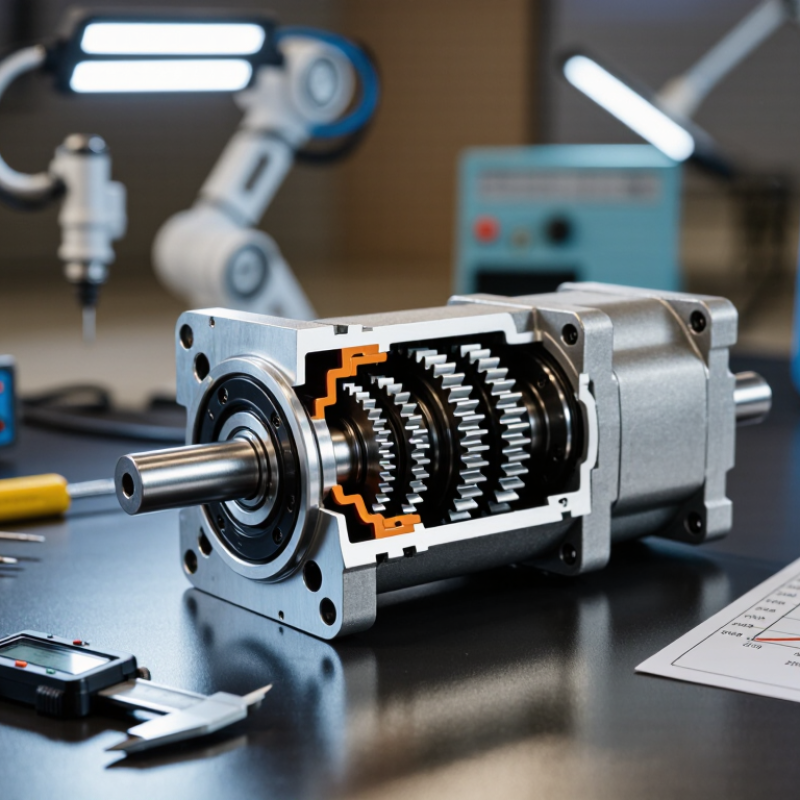
Choosing the 2026 best DC Planetary Gear Motor requires more than comparing advertised torque and price. Global buyers need dependable performance, clear documentation, and practical support after purchase. A suitable motor should match the application’s voltage, speed, load, duty cycle, noise limit, and installation space. Torque matters. So does control.
This guide examines how experienced engineers evaluate a DC Planetary Gear Motor for robotics, automated equipment, medical devices, smart logistics, and compact industrial systems. Planetary gearing can provide high torque in a small housing, but efficiency and heat behavior vary between designs. A motor that performs well in a laboratory may struggle inside a sealed enclosure or under repeated starts. Real operating conditions reveal more than a catalog headline.
Reliable selection also depends on measurable evidence. Buyers should review torque-speed curves, gearbox backlash, rated life, thermal limits, shaft tolerances, and inspection records. Supplier communication matters when samples, customization, or replacement parts are needed. International purchasers should also confirm product documentation, responsible manufacturing practices, and applicable market requirements before ordering.
No motor is perfect. A quieter model may deliver less peak torque, while a stronger gearbox may increase weight and cost. Some recommendations remain conditional because application data is often incomplete. That is why this comparison focuses on transparent criteria rather than exaggerated rankings. Small errors matter. By connecting engineering details with field experience, the guide helps buyers make a more defensible decision for 2026 and beyond.
A DC planetary gear motor combines a direct-current motor with a compact planetary gearbox. It changes electrical energy into controlled rotary motion. The motor spins a central sun gear, which drives several planet gears. These gears rotate inside a fixed ring gear. Their combined movement reduces speed and increases output torque.
The gear arrangement spreads force across multiple teeth. This design often delivers higher torque in a smaller housing than simpler gear systems. A 12-volt motor may suit portable equipment, while a 24-volt motor can support longer operation and lower current demand. Actual performance depends on winding design, gear ratio, load, duty cycle, and temperature. In practical testing, stall torque is especially important. Ignoring it can cause overheating or premature gear wear. That mistake is common, even among experienced buyers.
Tips: Check rated torque, stall current, gearbox backlash, noise, shaft size, and operating temperature. Request test data, dimensional drawings, and life-cycle results before placing a global order. Confirm insulation, ingress protection, and applicable safety documentation for the target market. A low price may look attractive, but unstable quality creates hidden costs. I would also test samples under real load, because catalogue values can feel optimistic. Small details matter.
For global buyers, the best DC planetary gear motor is not defined by torque alone. Start with rated voltage, continuous torque, peak torque, output speed, and duty cycle. The International Energy Agency reports that electric motor systems consume nearly half of global electricity. Small efficiency gains matter.
Check the motor at its real operating point. A 24 V motor producing 5 N·m continuously may overheat if used near its stall torque. Compare gearbox efficiency, reduction ratio, backlash, and thermal limits.
IEC 60034-30-1 provides a useful framework for motor efficiency classification, although many small DC gear motors fall outside its direct scope. That limitation deserves attention.
Use load data from the machine, not a catalog headline. Record acceleration time, shaft inertia, starts per hour, ambient temperature, and mounting position. For outdoor equipment, verify the IP rating under IEC 60529, plus corrosion resistance and cable protection.
The U.S. Department of Energy has reported that motor-driven systems represent about 70% of industrial electricity use, so efficiency and service life affect operating costs. Noise also matters. A quiet motor can still deliver poor control.
Engineers sometimes overlook backlash until positioning errors appear. A spreadsheet can mislead. Test one sample under real load before placing a large international order.
Choosing a DC planetary gear motor in 2026 requires more than comparing rated torque.
In field testing, planetary designs handle compact, high-load applications well. Their metal gear stages distribute force across several teeth. This reduces tooth stress during repeated starts. Still, housing quality and bearing support matter greatly.
Compare motor types against the working environment. Brushed motors usually cost less and simplify basic speed control. Brushless motors often provide longer service life and lower maintenance. They may require a compatible controller. For dusty conveyors, this difference becomes important. A worm gearbox may hold position better, but it usually loses more energy as heat. I once preferred a high-ratio gearbox for lifting equipment, then found its slow response unsuitable for rapid indexing.
Gear ratio selection should begin with load speed, not maximum torque. A 100:1 ratio can deliver strong output torque, but it may reduce efficiency and increase backlash. Check continuous torque, peak torque, output speed, duty cycle, and allowable radial load. Measure the real load, including acceleration. A simple test with a spring scale can expose optimistic estimates.
Control options deserve equal attention. PWM control works for straightforward speed adjustment. Encoders support accurate position and speed feedback. Closed-loop control is valuable when the load changes during operation. Verify encoder resolution, controller voltage, current limits, and braking behavior. Specifications can look complete while missing thermal data. Request samples and run them through the actual duty cycle before approving a global purchase. That extra test may reveal noise, heat, or inconsistent startup performance.
2026 Best DC Planetary Gear Motor for Global Buyers?
Global buyers should judge a DC planetary gear motor beyond catalog torque. Check rated voltage, continuous load, peak load, speed, backlash, noise, and thermal rise. A motor that performs well on a workbench may struggle after eight hours of operation. Ask for measured test data, not only nominal values. Sample units should run under your real load profile.
Compliance documents need careful review. Request material declarations, safety files, EMC information, and production test records. Requirements can differ between destination markets and final equipment categories. Verify whether documents match the exact motor model and revision. A familiar certificate can still be outdated. That detail is easy to miss.
Supply reliability depends on more than quoted lead time. Examine component traceability, batch control, inspection methods, and contingency plans. Ask how quickly replacement units can be produced during a shortage. Keep approved samples and written specifications for comparison. A spreadsheet may look complete, yet one missing tolerance can cause assembly problems. I would also allow extra time for customs checks and technical clarification. Perfect forecasts are rare. Practical buyers leave room for mistakes, engineering changes, and uneven demand.
2026 Best DC Planetary Gear Motor for Global Buyers?
2026 Market Trends and Applications for DC Planetary Gear Motors
In 2026, DC planetary gear motors are moving beyond simple motion control. Buyers now compare torque density, noise, thermal limits, and service access. In a packaging line, a compact motor may drive an indexing conveyor through repeated starts. An encoder checks each position. This demand is reshaping product specifications. Efficiency matters, but stable performance under load matters more. A motor that saves energy on paper can still fail when heat cannot escape.
Market demand is growing in warehouse robots, medical equipment, automated valves, agricultural sensors, and compact lifting systems. Low-voltage designs remain attractive because they simplify installation and reduce cabinet space. However, voltage alone is not enough. Engineers should examine backlash, shaft loading, duty cycle, and stall behavior. Planetary gears provide strong torque in a small housing, yet poor alignment can create harsh vibration. Field testing still beats a spreadsheet. A two-week endurance test may reveal grease migration, connector weakness, or unexpected acoustic peaks.
Global buyers increasingly request traceable materials, documented testing, and clear replacement procedures. Regional standards differ, so technical files require careful review before shipment. Suppliers should provide performance curves at realistic temperatures, not ideal laboratory conditions. Some projects specify maximum torque without defining acceleration time. That omission creates expensive surprises. It deserves attention. Future designs may add current monitoring, but extra electronics can complicate repairs. The right motor depends on the machine, environment, and maintenance team.
| Evaluation Dimension | Typical 2026 Specification or Range | What Global Buyers Should Evaluate | Relevant Market Trend or Application |
|---|---|---|---|
| Rated Voltage | 3–6 V, 12 V, 24 V, or 48 V DC | Match the motor to the available battery, control board, or industrial power supply. Lower-voltage systems are common in portable equipment, while 24 V and 48 V systems are widely used in industrial automation and mobile machinery. | Growing adoption of 24 V and 48 V architectures in automated equipment, mobile robots, material handling, and battery-powered systems. |
| Continuous Output Torque | Approximately 0.02–20 N·m, depending on motor size and gearbox stage | Use continuous torque for normal operating loads and peak torque for acceleration, startup, or temporary overloads. A safety margin is normally required to handle friction, shock loads, and duty-cycle variation. | Higher torque density is increasingly important where equipment designers need smaller actuators without sacrificing load capacity. |
| Gear Ratio | 3:1–1,000:1; common selections include 16:1, ೀ 64:1, 100:1, and 256:1 | Low ratios provide higher speed with moderate torque; high ratios provide greater torque and lower output speed. The required ratio should be calculated from load torque, target speed, acceleration, and duty cycle. | Modular multi-stage gearboxes are favored for applications requiring several speed and torque configurations from one motor platform. |
| Output Speed | Approximately 1–3,000 rpm, depending on input speed and ratio | Confirm no-load speed, rated-load speed, and speed regulation. Output speed can fall as load torque increases, especially in compact brushed motor systems. | Demand is rising for compact, low-speed actuators used in valves, grippers, dosing equipment, seat adjustment, and precision positioning. |
| Gearbox Efficiency | About 55–90%, depending on ratio, number of stages, lubrication, and load | Higher ratios and additional stages generally reduce efficiency. Buyers should compare measured efficiency at the actual operating torque and speed rather than relying only on a maximum value. | Energy efficiency is becoming a key purchasing criterion in battery-powered products and equipment operating continuously or intermittently throughout the day. |
| Motor Technology | Brushed DC or brushless DC motor combined with a planetary gearbox | Brushed motors can offer lower initial cost and simple control. Brushless motors typically provide longer service life, improved thermal performance, and better suitability for frequent or continuous operation. | Brushless configurations are gaining preference in robotics, medical equipment, automated guided vehicles, and applications with high operating hours. |
| Speed Feedback | No feedback, Hall sensors, magnetic encoder, or optical encoder | Open-loop motors may be adequate for simple fans, pumps, locks, and adjustment mechanisms. Encoders are preferred when accurate position, speed regulation, synchronization, or fault detection is required. | Integrated feedback is increasingly specified for collaborative automation, robotic joints, smart actuators, and closed-loop motion control. |
| Backlash | Approximately 1–3° for standard planetary gearboxes; lower values require specialized designs | Backlash affects positioning accuracy and repeatability. Buyers should check backlash at the output shaft under defined measurement conditions and load direction. | Low-backlash solutions are increasingly required in robotic grippers, camera systems, laboratory instruments, and compact positioning modules. |
| Operating Life | Several hundred to more than 10,000 operating hours, depending on load, speed, lubrication, and duty cycle | Request life calculations or test conditions based on the actual torque-speed profile. Gear wear, brush wear, bearing load, thermal stress, and shock loading all affect service life. | Global buyers are placing greater emphasis on predictive maintenance, replaceable modules, and documented life testing. |
| Ingress Protection | Common configurations range from open-frame designs to IP54–IP65; higher protection requires appropriate sealing | Choose protection according to dust, moisture, cleaning procedures, and installation location. A sealed gearbox does not automatically mean that the motor assembly has the same protection rating. | Demand for sealed motor-gearbox assemblies is increasing in outdoor equipment, warehouse automation, agricultural machinery, and mobile platforms. |
| Operating Temperature | Typically −20°C to +60°C; specialized designs may support wider ranges | Check allowable winding temperature, gearbox lubricant range, battery conditions, and starting torque at low temperature. Continuous operation near the thermal limit can shorten service life. | More equipment is being designed for cold-chain logistics, outdoor automation, high-temperature enclosures, and variable global climates. |
| Noise and Vibration | Often approximately 45–70 dB(A), depending on speed, load, gear geometry, motor type, and mounting | Ask for test distance, rotational speed, load condition, and measurement method. Proper alignment, lubrication, bearing quality, and housing rigidity strongly influence acoustic performance. | Low-noise operation is increasingly important in medical devices, office automation, smart home products, and indoor service robots. |
| Duty Cycle | Intermittent duty, cyclic duty, or continuous duty depending on thermal design | Calculate RMS torque and average power over the complete motion cycle. A motor suitable for short movements may overheat when used continuously at the same load. | Application-specific sizing is replacing simple maximum-torque selection as buyers seek smaller, more efficient, and more reliable systems. |
| Common Applications | Robotics, AGVs, electric locks, pumps, valves, medical devices, office automation, and smart appliances | Planetary gear motors are suitable where compact dimensions, high torque density, coaxial output, and controlled speed are important. | The strongest application momentum is associated with warehouse automation, compact robotics, battery-powered devices, and intelligent electromechanical systems. |
| Customization Requirements | Shaft geometry, mounting pattern, connector, cable length, encoder, brake, winding, gear ratio, and output bearing | Provide a complete technical specification before quotation, including load profile, dimensions, voltage, speed, torque, duty cycle, environment, and annual volume. | Platform-based customization helps global buyers reduce redesign time while maintaining common components across multiple product models. |
| Compliance and Documentation | Technical drawings, performance curves, material information, test reports, and applicable market compliance documents | Confirm documentation requirements for the destination market, electrical system, product category, and transportation conditions. Traceability and consistent test methods simplify supplier qualification. | Procurement teams increasingly evaluate suppliers on documentation quality, product consistency, lifecycle support, and sustainability information—not price alone. |

Subscribe to our newsletter for the latest news and exclusive offers.
We hold a long-term view when we build modular rooms taking into consideration your changing needs. Whether it’s shifting your workspace to a new site, redesigning your unit to fit new requirements, or simply clearing the area at the end of the project, our Dismantling & Reassembling teams are pressed into service to get the job done in the quickest possible time and minimum resource wastage.
We understand that every project is unique and therefore has a different set of requirements. That’s why we believe in customizing our solutions to fit individual needs. We are equipped with the right talents, technology, and skillset to offer bespoke modular units, without compromising on turnaround time or quality.
The benefits of choosing Containers ME continues long after the installation of the units as we provide aftersales service for as long as you need. All you have to do is sign the Annual Maintenance Contract (AMC) and enjoy technical support for all the maintenance-related issues. By signing the contract, you can rest assured that a highly professional team of dedicated staff are at your service all year round to attend to your needs.
We specialize in Customized Container Solutions designed to meet diverse needs across the UAE. Our offerings include customized modular containers that cater to various applications, from tailor-made container solutions to bespoke container designs.
Whether you’re looking for personalized container homes or custom modular containers, we have you covered. Our customized container offices provide functional workspaces, while our customized portable containers ensure flexibility on-site. Explore our range of custom container storage units and customized cargo containers to optimize your space.
We also offer custom container leasing and custom container fabrication services, along with customized sea containers designed for secure transport. For specialized needs, our specialized container modifications will help you create the perfect solution for your requirements in both Dubai and the broader UAE.