
Blogs

China Top 10 Hose Clamp Manufacturers?

Hose Clamps are small components, but they secure critical connections in vehicle, machinery, and fluid-handling systems. A loose clamp can cause leakage, vibration, or costly maintenance. Buyers therefore need more than an attractive catalogue and a competitive unit price.

China’s manufacturing scale makes supplier selection especially relevant. OICA’s 2023 production statistics recorded 30,160,966 motor vehicles produced in China, the highest national output that year. This figure signals a substantial industrial ecosystem, not proof that every supplier meets the same quality standard. Small parts matter. A manufacturer’s material choices, band-edge finish, tightening range, corrosion resistance, and production consistency all deserve close review.

This guide introduces ten notable Chinese hose clamp manufacturers and the factors buyers can use to compare them. These include product range, customization, testing practices, export experience, and the availability of technical documentation. In practice, a stainless-steel clamp for a marine environment may need different specifications from one used on a workshop air hose. Fit matters.

There is no universally accepted ranking of “top” manufacturers. Public company profiles and product catalogs rarely provide enough evidence to judge long-term field performance. Treat this list as a starting point, then confirm specifications, samples, and quality records directly with each supplier. That extra step can feel tedious. It is still wiser than choosing from a headline alone.
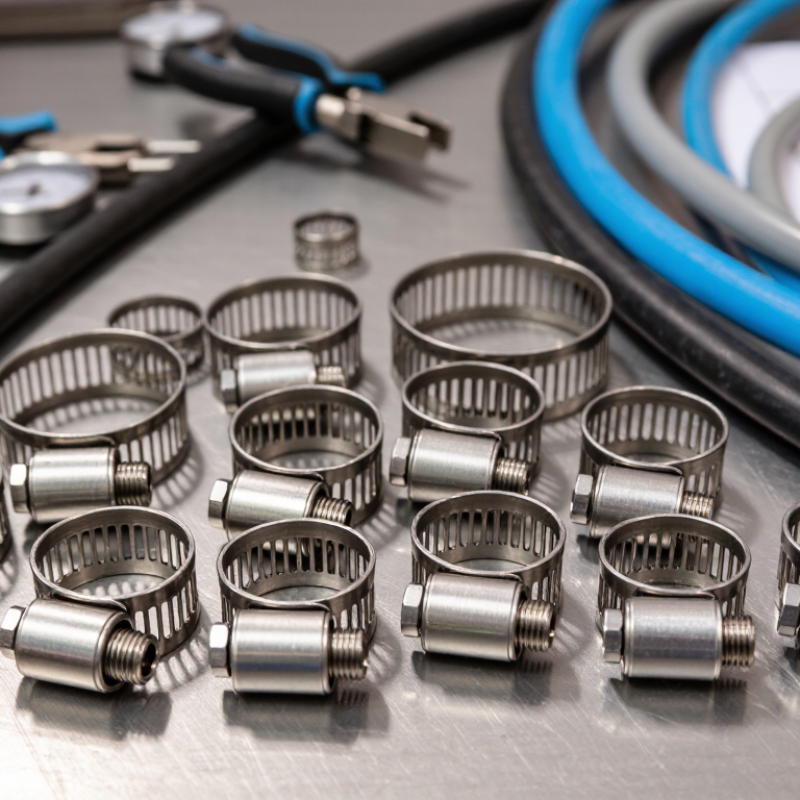
China Top 10 Hose Clamp Manufacturers?

What Hose Clamps Are and How They Work

A hose clamp is a fastening device that presses a flexible hose against a fitting. In a common screw-type clamp, turning the screw draws a perforated metal band tighter around the hose. The band’s pressure helps limit leaks and keeps the hose from slipping off under normal operating conditions. Spring and bolt-style clamps use different mechanisms, so their installation needs can vary.

Tips: Match the clamp’s diameter to the hose and fitting. Position it behind the fitting’s raised bead, where it can grip securely. Tighten gradually. Stop if the hose begins to bulge, split, or deform; more force does not always mean a better seal. Check the connection again after the system has run and cooled.

A clamp should suit the hose material, operating temperature, and expected pressure. For example, a soft hose can be damaged by a narrow band tightened too far. A loose clamp may allow seepage, while an overtightened one may cut into the hose. It is easy to focus only on the screw, but correct sizing and placement matter just as much. Even a neat-looking installation deserves a careful leak check.


Common Hose Clamp Types and Their Applications

Hose clamps secure flexible hoses to fittings, but one design does not suit every connection. Worm-drive clamps use a screw band and are common on automotive, workshop, and household hoses. They are adjustable and easy to inspect. Spring clamps maintain pressure as temperatures change, making them useful on cooling systems. T-bolt clamps provide a stronger, more even grip on larger hoses, such as those used in industrial air or fluid lines. Ear clamps offer a compact, fixed fit for repeatable production assembly. Each type has limits.

Choose a clamp that matches the hose material, outside diameter, fitting shape, and working conditions. A worm-drive clamp may be convenient, but tightening it too much can cut soft rubber or distort a thin hose. Spring clamps can be awkward to remove in a cramped space. T-bolt models may be unnecessary for a small, low-pressure connection. There is no perfect choice for every job; vibration, heat, and frequent servicing can change what works best.

Tips: Measure the hose over the fitting, not by its loose diameter. Position the clamp behind the fitting’s raised bead, then tighten it evenly. Check for leaks after the system runs and cools. A dry connection is a good sign, but it is not proof that the clamp will stay secure over time.

Counts represent the typical application examples listed for each clamp type, not market share or a ranking. Selection depends on hose material, diameter, pressure, temperature, vibration, and service requirements.

How to Evaluate Hose Clamp Manufacturers in China

Choosing a hose clamp manufacturer in China requires more than comparing prices. Start with the application: hose material, working pressure, temperature range, and exposure to moisture or chemicals. Ask what stainless steel grade or coating the clamp uses, and request material documents tied to the actual batch. Check how the band edges are finished; rough edges can damage soft hoses. Small details matter.

Review production controls, not just catalog photos. Ask how the manufacturer checks band width, screw fit, tightening torque, and corrosion resistance. Request recent test records and a sample from the same production process you would order. Confirm whether inspection reports identify batch numbers. A neat sample is useful, but it cannot prove consistent mass production. I would also ask what happens when a sample fails. Some suppliers may give vague answers; that deserves a follow-up.

Tips: Send a clear specification sheet and compare replies line by line. Ask about minimum order quantity, lead time, packaging, and inspection options before paying a deposit. Check whether the contact person can explain tolerances in plain language. Keep the first order modest if practical, then inspect several clamps from different cartons. This takes extra time, and it may not catch every issue, but it gives you better evidence than a low quote alone.

China’s Top 10 Hose Clamp Manufacturers

China’s top 10 hose clamp manufacturers are best compared by process control, material traceability, and application fit—not catalogue size alone. The China Association of Automobile Manufacturers reported 31.282 million vehicles produced in China in 2024, alongside 5.859 million vehicle exports. These figures indicate a large manufacturing base, but they do not directly measure hose-clamp demand. Buyers should still verify each factory’s actual production capacity and target industries.

For a shortlist, inspect band-edge finishing, screw engagement, and clamp consistency across sample batches. Ask for material certificates, dimensional inspection records, corrosion-test conditions, and documented tightening ranges. A clamp that looks polished may still cut into a soft hose or loosen under vibration. Small details matter. Check whether the supplier can explain how it controls those risks, rather than relying only on a general quality certificate. Compare prototypes using the same hose diameter and installation torque. One limitation in many supplier comparisons is that test methods differ, making results difficult to compare directly. That deserves more attention. A careful top-ten assessment should therefore weigh repeatability, technical support, and clear test evidence alongside price and delivery time.

China’s Top 10 Hose Clamp Manufacturers

Manufacturer evaluation benchmarks: use these technical standards and specifications to compare suppliers. No company or brand rankings are presented.

No. Comparison dimension Factual technical reference What to verify with the supplier
1 Worm-drive clamp design DIN 3017-1 covers worm-drive hose clamps. Request the applicable standard edition, dimensional range, and product drawings.
2 Clamp performance testing SAE J1508 specifies requirements and test methods for hose clamps. Check which tests apply to the offered clamp type and ask for test reports.
3 Stainless steel grade: 304 EN 1.4301 is a commonly used designation for 304 stainless steel; ASTM A240 covers stainless steel plate, sheet, and strip. Confirm the grade for each component and request material documentation.
4 Stainless steel grade: 316 EN 1.4401 is a designation for 316 stainless steel; ASTM A240 includes relevant stainless steel product forms. Verify whether the band, housing, and screw all use the specified grade.
5 Stainless fastener properties ISO 3506 specifies mechanical properties for corrosion-resistant stainless steel fasteners. Ask for the screw material grade and the relevant mechanical-property class.
6 Electroplated components ISO 4042 addresses electroplated coating systems for fasteners. Confirm coating type, thickness requirements, and applicable inspection records.
7 Corrosion testing ISO 9227 defines neutral, acetic acid, and copper-accelerated acetic acid salt-spray test methods. Specify the test method and acceptance criteria; the test method alone does not set a universal pass duration.
8 Material inspection documents EN 10204 describes types of inspection documents for metallic products, including type 3.1 certificates. State the required document type and confirm that it covers the actual production batch.
9 Size and dimensional control Clamp fit depends on the specified diameter range and the hose-and-fitting assembly dimensions. Compare the supplier’s size chart and drawing against the measured assembly, not hose nominal size alone.
10 Material-code clarity Codes such as W1, W2, W4, and W5 are used in the clamp trade, but definitions should be confirmed against each supplier’s specification. Request a component-by-component material breakdown rather than relying on a code alone.

How to Compare Suppliers, Certifications, and Product Quality

When comparing hose clamp suppliers, look beyond catalog size and price. Ask for current quality-system certificates, then check their scope, issuing body, and expiry date. ISO 9001 can indicate a managed quality process, but it does not certify every clamp. For automotive supply, IATF 16949 may be relevant; confirm whether the supplier’s production site is covered. Ask for evidence. Material certificates should identify the steel grade and, where applicable, the corrosion-resistant coating.

Product checks should match the clamp’s intended use. Request drawings with band width, thickness, diameter range, and tightening specifications. Inspect sample edges for burrs, then check whether the screw turns smoothly without binding. Ask how the supplier tests tightening performance and corrosion resistance, and whether results are traceable to a production lot. Details matter. A polished sample is useful, but it cannot show how consistently a factory produces thousands of units.

Compare suppliers using the same sample requirements and questions. Ask about inspection frequency, nonconforming-part handling, and changes to materials or tooling. Review actual test reports rather than relying on broad claims. Paperwork can look tidy while process details remain vague. That is a reason to ask follow-up questions, not an automatic rejection. A factory visit or independent inspection may help, though neither guarantees future consistency. Keep records of approved samples, specifications, and agreed tolerances before placing repeat orders.

Article Source:

Plug & Play Installation

Our installation services are top-notch, delivering modular systems for any application on time in plug & play condition. We leave nothing for you to figure out, set up, or fix. All you’ve to do is just step in, and get going with your business.

Dismantling & Reassembling

We hold a long-term view when we build modular rooms taking into consideration your changing needs. Whether it’s shifting your workspace to a new site, redesigning your unit to fit new requirements, or simply clearing the area at the end of the project, our Dismantling & Reassembling teams are pressed into service to get the job done in the quickest possible time and minimum resource wastage.

Interior Designing

Our interior designs combine both functional and aesthetic aspects to provide you with physical and emotional comfort. We ask you for your preferences and give the best possible solutions aligned to your tastes. Our units are built to be modern, stylish, and elegant.

Bespoke Solutions

We understand that every project is unique and therefore has a different set of requirements. That’s why we believe in customizing our solutions to fit individual needs. We are equipped with the right talents, technology, and skillset to offer bespoke modular units, without compromising on turnaround time or quality.

Aftersales Service

The benefits of choosing Containers ME continues long after the installation of the units as we provide aftersales service for as long as you need. All you have to do is sign the Annual Maintenance Contract (AMC) and enjoy technical support for all the maintenance-related issues. By signing the contract, you can rest assured that a highly professional team of dedicated staff are at your service all year round to attend to your needs.

Customized Container Solutions

We specialize in Customized Container Solutions designed to meet diverse needs across the UAE. Our offerings include customized modular containers that cater to various applications, from tailor-made container solutions to bespoke container designs.

Whether you’re looking for personalized container homes or custom modular containers, we have you covered. Our customized container offices provide functional workspaces, while our customized portable containers ensure flexibility on-site. Explore our range of custom container storage units and customized cargo containers to optimize your space.

We also offer custom container leasing and custom container fabrication services, along with customized sea containers designed for secure transport. For specialized needs, our specialized container modifications will help you create the perfect solution for your requirements in both Dubai and the broader UAE.

Get a quote

Get a quote



