
Blogs

Top 10 Industrial Floor Scrubber Types for Global Buyers

Industrial cleaning is becoming more data-driven, yet the floor remains brutally practical. A warehouse manager sees tire marks, oil residue, wet footprints, and battery limits every day. The right Industrial Floor Scrubber must remove these problems without slowing production. It must also fit aisle widths, floor coatings, labor skills, and maintenance routines.

Market research supports this shift. Grand View Research identifies rising demand for mechanized cleaning equipment, driven by hygiene expectations, labor shortages, and larger commercial facilities. MarketsandMarkets also highlights automation, battery operation, and sustainable cleaning technologies as important market forces. These reports indicate growth, but their market boundaries differ. Therefore, their figures should not be treated as perfectly interchangeable. That detail is easy to overlook.

Performance matters more than appearance. A compact walk-behind scrubber may suit a crowded retail store, while a ride-on machine can serve a distribution center more efficiently. Autonomous models may reduce repetitive labor, but they still require site mapping, supervision, and reliable obstacle detection. Water recovery, brush pressure, tank capacity, charging time, and after-sales support can decide the real operating cost.

This guide compares ten major Industrial Floor Scrubber types for global buyers. It considers cleaning output, maneuverability, energy use, operator training, and service access. ISO 50001 energy-management principles and sustainability guidance from the U.S. Environmental Protection Agency provide useful reference points, although they do not replace site testing. No ranking is universal. A machine that excels on polished concrete may disappoint on textured tiles. That is the uncomfortable part. Proper selection still depends on evidence from the actual floor.
Top 10 Industrial Floor Scrubber Types for Global Buyers

Industrial Floor Scrubber Basics and Key Classification Criteria

Industrial floor scrubbers combine water, chemical solution, mechanical agitation, and vacuum recovery. Their purpose is simple: remove soil while leaving a safer, drier surface. In field inspections, I classify machines by cleaning action, power source, operator position, and recovery method. No classification is perfect. Some machines fit several groups.

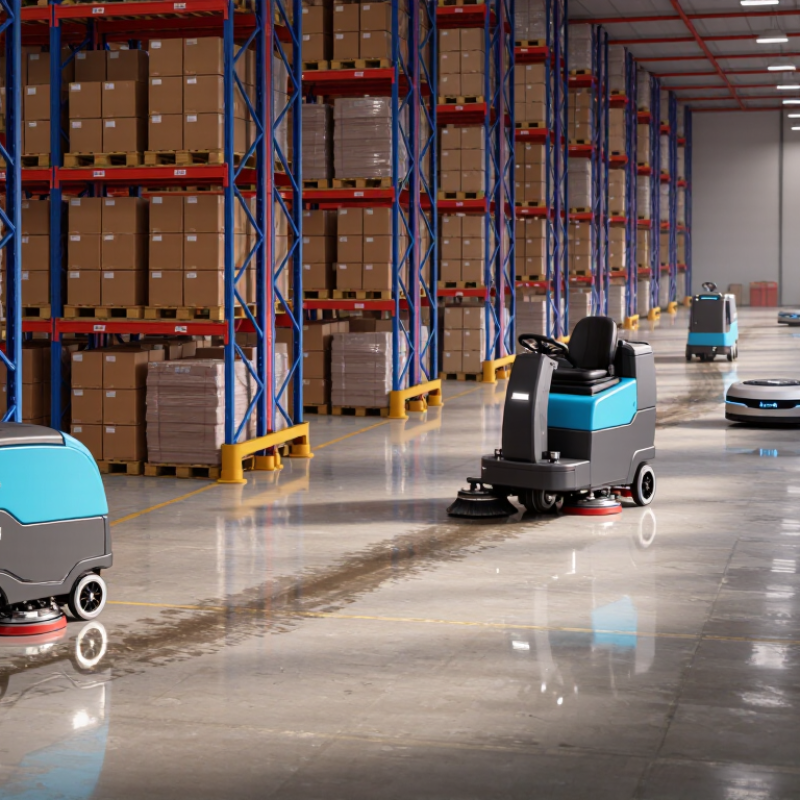
The common ten types include walk-behind, ride-on, compact, robotic, disc, cylindrical, orbital, battery-powered, corded electric, and industrial combination scrubbers. Disc machines suit smooth concrete and wide open aisles. Cylindrical brushes handle textured floors and collect small debris more effectively. Orbital models use less water and can support detail work near walls. Ride-on units cover large warehouses quickly, while compact machines work around racks and narrow doors. Robotic units require accurate mapping and consistent floor conditions.

Power selection deserves practical attention. Battery machines reduce cable hazards, but charging time and battery replacement affect productivity. Corded units provide steady operation, yet cables can obstruct forklifts and pedestrian routes. Recovery capacity matters too. A small tank may force repeated stops, even when the brush deck is highly efficient. Check brush pressure, turning radius, noise level, drying performance, and access to service parts. Measure the actual aisle width, not the drawing. A machine that looks compact may still scrape shelving. Operators also need clear controls, emergency stops, and training suited to wet-floor risks. That detail is often underestimated.


Top 10 Industrial Floor Scrubber Types for Global Buyers

Industrial floor scrubbers are commonly classified by operator method, mobility, cleaning mechanism, automation level, and cleaning-path width. The chart compares representative cleaning-path widths for major scrubber categories.

Values represent typical cleaning-path widths used in commercial and industrial equipment categories. Actual specifications vary by machine configuration, pad or brush size, and application.

Walk-Behind Scrubbers for Compact and Controlled Cleaning

Top 10 Industrial Floor Scrubber Types for Global Buyers

Walk-behind scrubbers suit compact facilities that need controlled, repeatable cleaning. Operators can guide them around shelving, columns, narrow aisles, and loading-area corners. Their smaller turning radius improves accuracy where ride-on machines may feel excessive. In practical evaluations, brush pressure, water flow, and recovery performance matter more than appearance. A clean pass should leave the floor damp, not flooded. Some models offer adjustable handles and low-noise operation, which helps in occupied warehouses, schools, and retail spaces. However, productivity depends heavily on operator training and walking speed.

These scrubbers work well on concrete, sealed tile, and other hard surfaces when the pad matches the floor. Using too much detergent can create residue and increase rinsing time. Battery-powered units reduce cable management, but charging access and runtime require planning. A machine may appear efficient on paper yet struggle with heavy soil or uneven flooring. That limitation deserves honest testing before purchase. Check tank capacity, brush width, recovery pickup, spare-part access, and local service support.

Tips: Measure aisle widths before selecting equipment. Test the scrubber on a small floor section first. Observe water pickup near joints and drains. Train operators to overlap each pass slightly. Clean the recovery tank after every shift, even when the machine looks lightly used. Small maintenance habits prevent unpleasant odors and inconsistent cleaning.

Ride-On Scrubbers for Large-Scale Industrial Facilities

Ride-On Scrubbers for Large-Scale Industrial Facilities

Ride-on scrubbers suit warehouses, factories, airports, and distribution centers with wide concrete aisles. Operators cover more floor with less walking and fewer turning delays. In field trials, cleaning performance depends on route design, not machine size alone. A 1.2-meter cleaning path can reduce repeated passes, but only when aisles remain clear. Capacity matters. Larger tanks also reduce refill interruptions during long shifts.

Grand View Research reported steady growth in the global industrial floor scrubber market through 2030, supported by warehouse expansion and stricter hygiene expectations. Fortune Business Insights also identified commercial and industrial facilities as major demand sectors in its floor cleaning equipment analysis. These reports support investment, but forecasts are not guarantees. I would compare them with local labor costs, water access, floor coatings, and service availability.

For global buyers, battery capacity deserves careful testing. A scrubber may advertise a full-shift runtime, yet heavy soil, cold storage, and frequent acceleration can shorten it. Test the machine on actual floors. Check recovery performance near dock doors, where dust and water often mix. Noise levels matter in active facilities. Safety visibility matters more. Include operator training, spare parts, charging infrastructure, and maintenance response in the purchase calculation. The cheapest machine may become expensive when downtime starts. That lesson is easy to miss.

Top 10 Industrial Floor Scrubber Types for Global Buyers - Ride-On Scrubbers for Large-Scale Industrial Facilities

No. Ride-On Scrubber Type Typical Cleaning Width Theoretical Productivity Solution / Recovery Tank Typical Operating Time Best-Fit Industrial Applications Main Advantages Key Limitations
1 Battery-Powered Disc Scrubber 70–130 cm 4,000–8,000 m²/h 80–250 L / 90–280 L 3–6 hours per charge Warehouses, factories, logistics hubs, distribution centers, and paved production areas Balanced cleaning performance, low local emissions, and broad brush availability Recharge time; less effective on heavily textured or deeply grooved floors
2 Cylindrical Brush Scrubber 70–120 cm 3,500–7,500 m²/h 80–220 L / 90–250 L 3–6 hours per charge Textured concrete, loading docks, food-processing floors, and areas with loose debris Cleans floor grooves while collecting light dry debris in a single pass Higher brush maintenance and generally lower polishing capability than disc systems
3 Heavy-Duty Ride-On Scrubber 90–150 cm 5,000–10,000 m²/h 150–350 L / 170–400 L 4–8 hours per charge Large manufacturing plants, steel facilities, airports, and high-traffic industrial campuses Large tanks, high traction, long duty cycles, and robust chassis construction Higher purchase cost, larger turning radius, and greater storage requirements
4 Compact Ride-On Scrubber 55–85 cm 2,500–5,000 m²/h 50–120 L / 60–140 L 2.5–5 hours per charge Narrow aisles, workshops, retail warehouses, parking structures, and mixed-use facilities Small turning radius, easier transport, and good access around equipment and shelving Smaller tanks and lower output for very large open areas
5 High-Pressure Scrubber 80–130 cm 3,000–7,000 m²/h 100–250 L / 110–280 L 3–6 hours per charge Oil-contaminated workshops, maintenance bays, heavy equipment areas, and service depots Higher contact pressure helps remove bonded soil and industrial residues May increase water and detergent use; unsuitable for delicate floor coatings
6 Orbital Ride-On Scrubber 70–120 cm 3,000–6,500 m²/h 80–220 L / 90–250 L 3–6 hours per charge Coated concrete, resilient flooring, facilities requiring low-moisture cleaning, and renovation work Can clean with relatively low water use and supports floor preparation or light stripping Usually slower than wide disc machines and may require specific pads
7 Sweeper-Scrubber Combination 90–150 cm 5,000–10,000 m²/h 150–350 L / 170–400 L 4–8 hours per charge Cement plants, foundries, distribution centers, and facilities with dust and wet soil Removes loose debris and washes the floor in one operating sequence More complex maintenance and higher cost than a dedicated scrubber
8 Wet-Dry Industrial Scrubber 80–140 cm 4,000–8,500 m²/h 100–300 L / 120–350 L 3–7 hours per charge Industrial workshops, repair facilities, transport terminals, and mixed wet-and-dry environments Handles changing soil conditions and supports both pre-sweeping and wet recovery Can be oversized for routine light cleaning and requires frequent debris-container care
9 Low-Noise Electric Scrubber 60–110 cm 3,000–6,500 m²/h 70–200 L / 80–230 L 3–6 hours per charge Pharmaceutical plants, food facilities, indoor logistics centers, and noise-sensitive operations Quiet operation, zero tailpipe emissions, and suitability for indoor use Battery charging infrastructure is required; output is generally below heavy-duty models
10 Long-Run-Time Scrubber with Battery Exchange 80–140 cm 4,000–9,000 m²/h 120–300 L / 140–350 L 6–12 hours with planned battery exchange Continuous-shift manufacturing, large warehouses, airports, and multi-shift industrial operations Minimizes downtime when spare charged batteries and trained operators are available Requires additional batteries, lifting equipment, charging space, and safety procedures

Note: The specifications shown are typical market ranges for ride-on industrial floor scrubbers. Actual productivity, tank capacity, runtime, and cleaning width vary according to machine configuration, brush pressure, floor condition, operator speed, battery capacity, and site layout.

Robotic Scrubbers for Automated Floor Maintenance

Robotic scrubbers are becoming a practical option for automated floor maintenance in warehouses, airports, hospitals, and large retail facilities. They follow mapped routes, control water flow, and return to charging stations with limited operator support. In busy sites, this can reduce missed cleaning zones and keep staff away from repetitive overnight work.

A reliable buying decision starts with the floor itself. Smooth concrete, textured tiles, narrow aisles, and changing light can affect navigation and cleaning results. Buyers should check brush pressure, recovery-tank capacity, battery runtime, noise levels, and obstacle detection. A machine that cleans 3,000 square meters per hour may perform poorly around shelving, door thresholds, or wet loading areas. Site trials matter.

Small details often decide daily performance. Operators need clear alerts, simple tank access, and filters that can be cleaned without special tools. Data reports can show route completion, water use, and recurring dirty spots. However, automation is not magic. Sensors may need adjustment, maps can become outdated, and edge cleaning may remain incomplete. A pilot test can reveal these weaknesses before large-scale purchasing. Maintenance records and trained staff still matter, even when the scrubber works independently.

Choosing the Right Scrubber Type for Global Purchasing Needs

Top 10 Industrial Floor Scrubber Types for Global Buyers

Choosing the Right Scrubber Type for Global Purchasing Needs

Selecting an industrial floor scrubber starts with the facility, not the machine catalogue. In facility audits, I have seen buyers choose powerful equipment that could not turn inside narrow aisles. Fit matters more. The main options include walk-behind, ride-on, stand-on, compact, robotic, disc, cylindrical, orbital, battery-powered, and corded electric scrubbers.

Walk-behind machines suit smaller warehouses and areas with frequent obstacles. Ride-on models reduce labor time across large distribution centers. Cylindrical brushes handle textured floors and light debris, while disc brushes perform well on smooth concrete. Orbital systems can support delicate surfaces with controlled pressure. Robotic scrubbers may improve routine coverage, but they need clear routes, mapping, and reliable supervision.

Power selection requires careful local planning. Battery models reduce cable risks, yet charging time, battery replacement, and temperature conditions affect productivity. Corded units offer continuous operation, but electrical standards and outlet locations vary between countries. A diesel-powered solution may appear practical outdoors, but indoor air quality can make it unsuitable.

I recommend testing each shortlisted type on the actual floor. Measure cleaning width, water recovery, noise, turning radius, and operator visibility. Test it onsite. Procurement teams should also verify spare-part access, technical training, warranty terms, and service response in the destination market. A lower purchase price can hide expensive downtime. That assumption can fail. The best global choice balances surface conditions, labor availability, local infrastructure, and long-term maintenance rather than headline capacity.

Plug & Play Installation

Our installation services are top-notch, delivering modular systems for any application on time in plug & play condition. We leave nothing for you to figure out, set up, or fix. All you’ve to do is just step in, and get going with your business.

Dismantling & Reassembling

We hold a long-term view when we build modular rooms taking into consideration your changing needs. Whether it’s shifting your workspace to a new site, redesigning your unit to fit new requirements, or simply clearing the area at the end of the project, our Dismantling & Reassembling teams are pressed into service to get the job done in the quickest possible time and minimum resource wastage.

Interior Designing

Our interior designs combine both functional and aesthetic aspects to provide you with physical and emotional comfort. We ask you for your preferences and give the best possible solutions aligned to your tastes. Our units are built to be modern, stylish, and elegant.

Bespoke Solutions

We understand that every project is unique and therefore has a different set of requirements. That’s why we believe in customizing our solutions to fit individual needs. We are equipped with the right talents, technology, and skillset to offer bespoke modular units, without compromising on turnaround time or quality.

Aftersales Service

The benefits of choosing Containers ME continues long after the installation of the units as we provide aftersales service for as long as you need. All you have to do is sign the Annual Maintenance Contract (AMC) and enjoy technical support for all the maintenance-related issues. By signing the contract, you can rest assured that a highly professional team of dedicated staff are at your service all year round to attend to your needs.

Customized Container Solutions

We specialize in Customized Container Solutions designed to meet diverse needs across the UAE. Our offerings include customized modular containers that cater to various applications, from tailor-made container solutions to bespoke container designs.

Whether you’re looking for personalized container homes or custom modular containers, we have you covered. Our customized container offices provide functional workspaces, while our customized portable containers ensure flexibility on-site. Explore our range of custom container storage units and customized cargo containers to optimize your space.

We also offer custom container leasing and custom container fabrication services, along with customized sea containers designed for secure transport. For specialized needs, our specialized container modifications will help you create the perfect solution for your requirements in both Dubai and the broader UAE.

Get a quote

Get a quote



