
What is an Ftir Spectroscopy Machine, and why does it matter in modern laboratories? This instrument identifies chemical bonds by measuring infrared light absorbed by a sample. A compact spectrum can reveal polymers, solvents, pharmaceuticals, coatings, and contaminants within minutes. Often, little or no sample preparation is required. That practical advantage supports faster decisions and reduces material waste.
Peter R. Griffiths, a respected authority in infrared spectroscopy, described FTIR as “one of the most versatile analytical techniques available.” His observation remains relevant. A laboratory technician can place a powder, film, liquid, or gas into the sampling area and obtain a molecular fingerprint. ATR accessories simplify routine testing. Transmission cells support more controlled measurements. However, results still depend on calibration, background correction, sampling quality, and trained interpretation.
Industry reports show sustained demand. Grand View Research has identified FTIR as an important segment within the broader spectroscopy market. MarketsandMarkets also projects continued growth for infrared spectroscopy, driven by pharmaceutical quality control, environmental testing, food analysis, and polymer research. Reported market values differ because researchers use different product definitions. That variation deserves attention. A machine is not automatically accurate because it is expensive. Reliable performance requires traceable standards, suitable accessories, preventive maintenance, and documented methods. In practice, a clean crystal, stable background, and correctly chosen spectral library often matter more than impressive specifications. This guide examines the technology, operating principles, applications, limitations, and purchasing considerations behind an Ftir Spectroscopy Machine.
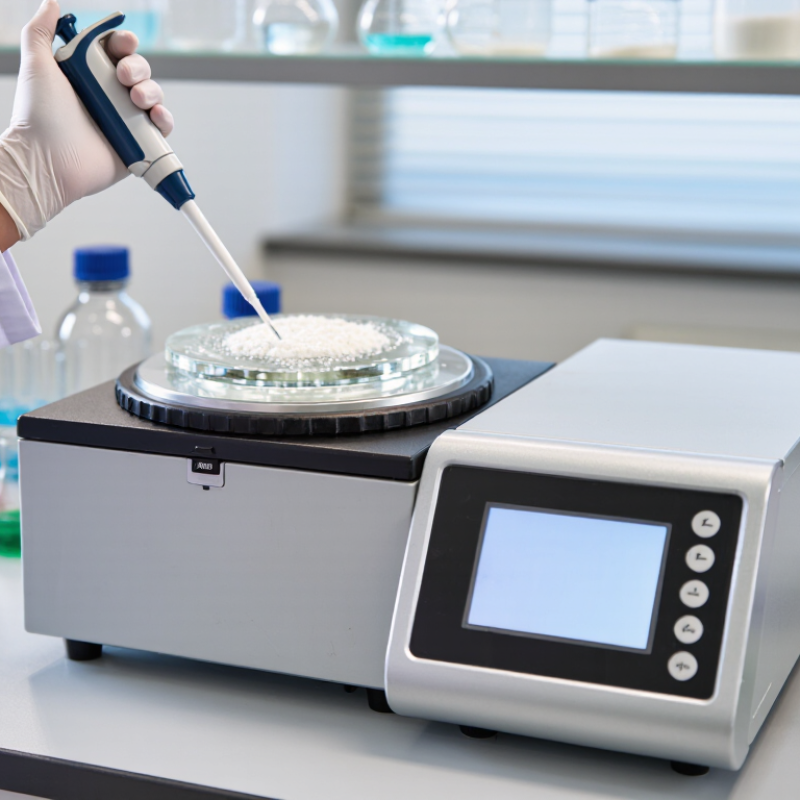
An FTIR spectroscopy machine measures how a sample absorbs infrared light. FTIR means Fourier-transform infrared spectroscopy. The instrument sends infrared energy through, or onto, a sample. Different chemical bonds absorb different infrared frequencies. The result is an infrared spectrum, often called a molecular fingerprint.
It is not magic. A trained user places a solid, liquid, or gas into the correct sampling accessory. The machine records absorption across a broad infrared range. Software then helps compare the pattern with reference spectra. In practice, this can reveal functional groups, contamination, moisture, or changes in material composition. For example, a polymer film may show strong bands linked to carbonyl or hydroxyl groups. Clean sample handling matters. Fingerprints, dust, and leftover solvent can distort the spectrum.
FTIR spectroscopy is useful in laboratories, manufacturing checks, environmental testing, and academic research. Yet the machine does not automatically identify every substance with certainty. Similar compounds can produce overlapping peaks. A weak signal may result from poor contact, an unsuitable accessory, or an insufficient sample quantity. Experienced analysts check peak positions, signal quality, preparation methods, and reference data together. Sometimes, the first interpretation is wrong. That is normal. Repeating the measurement and testing a known reference can expose the mistake. Calibration, background scans, and controlled conditions also improve reliability.

What Is an FTIR Spectroscopy Machine?
How an FTIR Spectroscopy Machine Works
An FTIR spectroscopy machine identifies chemical bonds by measuring how a sample interacts with infrared light. The instrument sends infrared radiation toward an interferometer, which contains a beam splitter and moving mirror. These parts create changing light patterns called an interferogram. The sample then absorbs specific infrared frequencies. A detector records the remaining signal.
The instrument does not directly produce a familiar spectrum. Software applies a Fourier transform to the interferogram, converting time-based data into a graph of intensity versus wavenumber. Peaks often represent stretching or bending vibrations from chemical bonds. The region below about 1500 cm⁻¹ can act like a molecular fingerprint, although interpretation still requires trained judgment.
Small details affect the result. Moisture, dirty windows, uneven contact, or an unstable background can create misleading peaks. A careful operator usually collects a background scan before testing and cleans the sampling surface between measurements. With ATR testing, the sample must press firmly against the crystal. Not always perfectly. A weak contact can reduce signal strength and hide important features. Experienced analysts compare the spectrum with reference data, inspect unexpected peaks, and repeat questionable measurements instead of trusting software alone. Temperature, particle size, and sample thickness may also change the spectrum. This is why FTIR analysis combines precise hardware with practical laboratory discipline.
What Is an FTIR Spectroscopy Machine?
An FTIR spectroscopy machine identifies chemical bonds by measuring infrared absorption. Its core system uses an interferometer, not a traditional wavelength-by-wavelength scan. The interferometer combines infrared paths and creates an interference pattern. A computer converts this signal through Fourier transformation.
Key components determine the instrument’s performance. The infrared source provides stable radiation across a broad range. A beamsplitter divides and recombines the beam. Fixed and moving mirrors control optical travel. The sample compartment holds liquids, powders, films, or gas cells. The detector records the returning signal, while software produces the spectrum. ASTM E1252 describes recommended practices for obtaining infrared spectra, including suitable resolution and sampling conditions. Many laboratory instruments cover approximately 4,000–400 cm⁻¹, though the usable range depends on the source, beamsplitter, and detector. The NIST Chemistry WebBook provides reference spectra that analysts commonly use for comparison.
Tips: Check the desiccant, clean the sampling crystal, and collect a background spectrum before testing. Moisture can create misleading bands near 3,400 and 1,640 cm⁻¹. In routine work, I also inspect the baseline before trusting a library match. A strong match is not proof. Sample thickness, pressure, contamination, and particle size can change the result. No setup is perfect, and even experienced users sometimes overlook a weak atmospheric signal. Record the accessory, resolution, scans, and preprocessing settings with every measurement.
What Is an FTIR Spectroscopy Machine?
An FTIR spectroscopy machine measures how a sample absorbs infrared light. These absorption patterns reveal its molecular structure and chemical bonds. The instrument produces a spectrum that analysts compare with validated reference data. It is fast, requires little sample material, and often supports non-destructive testing.
Common Applications of FTIR Spectroscopy
In manufacturing, FTIR spectroscopy helps identify raw materials before production begins. A small polymer pellet can reveal whether the correct resin has arrived. Analysts also examine finished plastics, coatings, rubber, fibers, and adhesives for composition changes. This supports quality control and helps investigate cracks, discoloration, or unexpected odors.
Pharmaceutical laboratories use FTIR to verify ingredients and detect possible contamination. Food laboratories can examine oils, powders, and packaging materials. Environmental teams may analyze surface residues, airborne particles, and water-related samples after suitable preparation. Attenuated total reflectance allows direct testing of many solids and liquids. Transmission methods can provide clearer results for thin films or prepared pellets.
It is not magic.
A spectrum can mislead when a sample is dirty, uneven, or chemically mixed. Water vapor may also interfere with certain measurements. Experienced users check background scans, control sample thickness, and repeat questionable tests. Reference libraries are helpful, but they should not replace professional judgment. FTIR often identifies functional groups confidently, yet some compounds require complementary methods for final confirmation. That limitation deserves attention.
| Application Area | Typical Sample Types | What FTIR Measures | Common Uses | Suitable Sampling Method | Key Considerations |
|---|---|---|---|---|---|
| Polymer and Plastic Analysis | Films, pellets, molded parts, fibers, and polymer powders | Characteristic infrared absorption bands associated with polymer functional groups | Polymer identification, comparison of incoming materials, contamination checks, and oxidation or degradation assessment | ATR, transmission film holder, or diffuse reflectance | Reference spectra and adequate surface contact improve identification reliability |
| Pharmaceuticals | Active ingredients, excipients, tablets, powders, and creams | Molecular vibrations, chemical composition, and changes in functional groups | Raw-material verification, formulation checks, polymorph screening, and detection of unexpected substances | ATR, transmission, or diffuse reflectance | Mixtures may produce overlapping bands; chemometric methods can assist interpretation |
| Food and Agriculture | Oils, grains, flour, dairy products, beverages, and plant materials | Absorption patterns related to fats, proteins, carbohydrates, and water | Ingredient screening, quality control, adulteration studies, moisture assessment, and composition modeling | ATR, transmission, or diffuse reflectance | Calibration models are often required for quantitative measurements |
| Chemical Identification | Organic liquids, solids, powders, and reaction products | Functional groups and molecular fingerprints in the mid-infrared region | Material identification, reaction monitoring, purity screening, and verification of chemical intermediates | ATR crystal, liquid cell, or transmission cell | Strongly absorbing or highly concentrated samples may require dilution or a shorter path length |
| Environmental Testing | Soil, sediments, airborne particulates, water residues, and organic contaminants | Infrared signatures of minerals, organic compounds, and surface deposits | Microplastic screening, soil characterization, contaminant studies, and analysis of collected residues | ATR, diffuse reflectance, or transmission after filtration | Water absorbs strongly in parts of the infrared region and may interfere with some measurements |
| Petrochemical Analysis | Fuels, lubricants, crude-oil fractions, and hydrocarbon mixtures | C–H, carbonyl, and other chemical-bond vibrations | Fuel comparison, oxidation monitoring, additive screening, and quality-control testing | ATR or liquid transmission cell | Quantitative results generally depend on validated calibration procedures |
| Forensic Science | Fibers, paints, adhesives, drugs, residues, and unknown powders | Unique absorption patterns used as molecular fingerprints | Unknown-material identification, trace-evidence comparison, and residue characterization | ATR, microscope accessory, or transmission | Small samples can be examined, but sampling must preserve chain-of-custody requirements |
| Coatings and Surface Analysis | Paints, protective coatings, thin films, and treated surfaces | Surface chemical composition and curing-related functional groups | Coating identification, cure monitoring, defect investigation, and surface-treatment verification | ATR or infrared microscopy | ATR primarily probes a shallow region near the sample surface |
| Biological and Medical Research | Proteins, lipids, cells, tissues, and biological extracts | Absorption bands associated with proteins, lipids, carbohydrates, and nucleic acids | Biomolecular studies, tissue characterization, cell research, and monitoring of biochemical changes | ATR, transmission, or infrared microscopy | Water interference and sample heterogeneity should be considered during method development |
| Failure and Contamination Analysis | Deposits, residues, fractured components, powders, and unknown surface materials | Chemical fingerprints of contaminants and degradation products | Root-cause investigation, process troubleshooting, foreign-particle identification, and defect analysis | ATR, infrared microscope, or diffuse reflectance | Clean background measurements and representative sampling are essential |
| Main Instrument Region | Most routine solid, liquid, and gas samples | Usually the mid-infrared region, approximately 4,000–400 cm−1 | Detection of fundamental molecular vibrations and functional-group signatures | Depends on sample form and accessory configuration | The exact usable range varies with the instrument, beam splitter, detector, and accessories |
| Primary Output | Measured sample and background spectrum | Infrared absorbance or transmittance plotted against wavenumber | Qualitative identification, spectral comparison, and quantitative analysis with calibration | Software-based spectral processing and library matching | A spectrum is not automatically a complete identification; interpretation requires suitable references and controls |
| Major Advantages | Many solids, liquids, and gases with minimal preparation | Rapid chemical-fingerprint information from molecular vibrations | Fast screening, non-destructive or minimally destructive testing, and broad material compatibility | ATR is commonly used for direct surface measurements | Results depend on sample contact, preparation, spectral quality, and analyst interpretation |
An FTIR spectroscopy machine identifies chemical bonds by measuring infrared light absorption. Each material produces a spectrum with distinctive peaks. Analysts compare these peaks with validated reference data. In routine laboratory work, a few drops of liquid or a small powder sample may be enough. Results often appear within minutes. It is fast. Sample preparation is usually simple, and many tests are non-destructive.
FTIR analysis supports material identification, contamination checks, and quality control. It can examine solids, liquids, films, and gases with suitable accessories. The technique also reduces solvent use and can monitor changes after heating, curing, or aging. An attenuated total reflectance accessory makes direct surface measurements practical. However, convenience can create overconfidence. A clear spectrum does not automatically prove a sample’s identity.
Water may obscure important infrared bands, especially in humid samples. Overlapping peaks can make mixtures difficult to interpret. Surface measurements may not represent the entire object. Quantitative results require suitable calibration, consistent sampling, and controlled conditions. A reference library is helpful, but it cannot replace scientific judgment. Poor contact, an uneven surface, or an incorrect background correction can distort the spectrum. Context matters. FTIR is powerful, yet it is not a universal answer. Experienced analysts should question unexpected peaks and repeat questionable measurements rather than forcing a match.
Subscribe to our newsletter for the latest news and exclusive offers.
We hold a long-term view when we build modular rooms taking into consideration your changing needs. Whether it’s shifting your workspace to a new site, redesigning your unit to fit new requirements, or simply clearing the area at the end of the project, our Dismantling & Reassembling teams are pressed into service to get the job done in the quickest possible time and minimum resource wastage.
We understand that every project is unique and therefore has a different set of requirements. That’s why we believe in customizing our solutions to fit individual needs. We are equipped with the right talents, technology, and skillset to offer bespoke modular units, without compromising on turnaround time or quality.
The benefits of choosing Containers ME continues long after the installation of the units as we provide aftersales service for as long as you need. All you have to do is sign the Annual Maintenance Contract (AMC) and enjoy technical support for all the maintenance-related issues. By signing the contract, you can rest assured that a highly professional team of dedicated staff are at your service all year round to attend to your needs.
We specialize in Customized Container Solutions designed to meet diverse needs across the UAE. Our offerings include customized modular containers that cater to various applications, from tailor-made container solutions to bespoke container designs.
Whether you’re looking for personalized container homes or custom modular containers, we have you covered. Our customized container offices provide functional workspaces, while our customized portable containers ensure flexibility on-site. Explore our range of custom container storage units and customized cargo containers to optimize your space.
We also offer custom container leasing and custom container fabrication services, along with customized sea containers designed for secure transport. For specialized needs, our specialized container modifications will help you create the perfect solution for your requirements in both Dubai and the broader UAE.




